I feel a little sheepish posting this, but I hope you'll all forgive the shameless plug, as this is quite exciting for me:
My first published piece!
Thanks to everyone who encouraged me to expand outside the blog!
Thursday, February 28, 2008

Back To School
It was lunchtime when we arrived, five people in two taxis and one via bicycle, at Fuchu Elementary School #10. We were expected, of course, but were welcomed only by shrieking children, each nudging their neighbor, “Hey, get a look at who’s here.”
The “who” – well, “we,” – was the group of students that our university had selected to go to participate in Fuchu Elementary’s International Day: Claire from England, Usu from Cote d’Ivorie, Bibi from China, Samu from Finland, Zare from Brasil and myself, feeling quite unexotic indeed.
As we walked towards the main building, various children gawked, whispered “foreigner” to their friends; a few teachers poked their heads out of classroom windows to say hello and direct us to the principal.
The main entrance to the school was like a regular genkan, the typical entryway to a Japanese home: the floor was a few inches below the floor of the school building, and the walls were lined with hundreds of drawers where the students put their shoes before changing into their classroom slippers. I put on a pair, a few sizes too small, and shuffled over to the principal’s office, where we were seated and offered tea.
The principal’s office was charmingly cluttered. There seemed to be a thin layer of dust on everything. A half-erased chalkboard calendar hung on one wall, flanked by notices and other random-looking papers attached with pushpins. On the other wall, close to the ceiling, hung portraits of the 11 previous principals of the school, ten of whom were business-like men, and one of whom was an absolutely terrifying woman whom I was afraid would materialize at any moment to correct my posture, inform me that my behavior was “unacceptable,” and request a conversation with my parents. Each portrait was angled downward from its point high up on the wall, giving the impression that each principal was watching my every move, looking down at me with disgust and pity. I got the urge apologize for things I hadn’t done. If the pictures were positioned that way as a psychological maneuver to make students afraid of stepping out of line, well… it worked.
All of this in contrast to the current principal, who was so gentle a woman that I feared shaking her hand may crush it. Dressed in a conservative gray frock, she spoke softly and slowly, thanking us for coming because we must be very busy, reiterating how excited the children were to see us. Working in elementary education for 27 years, this was her first post as a principal. Even when speaking about the problems that face elementary school children in Japan (bullying resulting in refusal to go to school, overcrowded classrooms, hyperactive kids [sound familiar?]), she did so with a smile on her face and an attitude that spoke of infinite patience and perseverance. When she cited numbers, she held up as many digits for us to see; for larger numbers, she would extend five fingers on her left hand, in the palm of which she would place the remaining digits from the right hand.
A teacher and a few students came to the door and told us that the performance was about to start. Lead upstairs by an unbelievably nervous boy, who would walk ahead of me, stop, look back to make sure I was still coming, then start walking again before we got too close, we emerged on the roof, where around 120 students were waiting. We sat in front of them; Mt. Fuji was visible behind us, in the hazy distance. One of the students came to the front and, speaking through a megaphone, asked her classmates to be quiet, then welcomed us and said how excited everyone was to learn about our countries.
One by one, the three classes performed songs and dances for us off to the right, as the remaining students in the front row tried to guess which foreigner was from where. Upon their conclusion, each of us was handed the megaphone and asked our opinion of the performances. I can’t quite remember what I said but I do remember being glad that my Japanese teacher wasn’t there to hear it. It appeared that the children were too busy recovering from the shock of seeing foreigners speaking Japanese to care much about my grammar. Thankfully.
The six of us were to go two-by-two to the three different classrooms; I was paired with Samu from Finland, and we were lead to the first classroom by a small group much in the same way I was lead up to the roof, save for one tiny little boy who, in a voice barely over a whisper, and without making any eye contact with me at all, asked me how many people were in my family, how many were boys, and what did I eat at dinner with my family.
My assignment had been to give a presentation about America, but I had been unsure as to what 10-year old Japanese students already knew, or what they wanted to know. I told them about my hometown, about what my elementary school was like, and what I ate for lunch. I asked them what American foods they knew (“Hamburgers!”), what kinds of foods they liked (“Hamburgers!”), and what they thought a normal American student their age ate for lunch (“Hamburgers!”). As for famous American people they knew, their answers, in order of appearance, were, Bush, (they didn’t say which one) Clinton (they didn’t say which one), and Babe Ruth.
When I asked them what other American things they knew, the many of the boys screamed, “Baseball!”
“How about other than baseball?”
Silence.
“Baseball!”
The females of the group asked very good questions, and in general were much better behaved. One girl came up to me afterwards and asked me in all seriousness if I had any children. I did not enjoy this question. Another girl had brought a dreamcatcher her dad had brought back from a business trip to America. I saw her holding it, standing in my general vicinity, eyes towards the ground, looking very nervous. I felt similarly. Getting down to her level, I asked her what it was and if she knew what it was supposed to do. Biting her lip to hold back a smile, I told her that I had had a dreamcatcher when I was younger, too. She relaxed a bit and smiled fully; this melted me.
While preparing for the visit, I thought that the perspective I would gain from going to talk to these kids would be related to my identity as an American, something that I had never thought about fully until I began to feel uncomfortable, why I’m still not sure, claiming it to be “where I’m from.” I was worried about what these children’s image of America would be. Fat? Greedy? Loud? Warmongering? Gun-toting? Would I have to answer questions about the Iraq War, about Hiroshima, about racism?
As it turned out, they really didn’t have much of a well-formed image about America at all. Some had been to Hawaii but did not realize it was part of America. (To be fair, this is probably true of many Americans as well.) It was exactly this that left its mark on me through this experience at the school, and it’s something that I often come upon while traveling. One of the many humbling experiences involved in living abroad is discovering that there is a vast world with no relation to one’s own.
The place I long for and call home, those children had never heard of. The language I speak, they don’t understand. People who have hurt me and those whom I have wronged, who remain in my memory, stubborn and unmoving – those people the children will never meet. It’s an awe-inspiring thing to realize, though it is also at times frightening to think that everything I hold dear and that has contributed to making me who I am are entirely meaningless to nearly the entire world population, save my family and those with whom I am close. With this in mind, it is quite hard to take oneself so seriously as to lose proper perspective, a crime that I’m often guilty of and something that I feel travel is the best cure for.
Back in the principal’s office, the six of us talked again with the principal and some teachers about the visit, and about their students. The conversation came, as it often does, to each of our hometowns. When it was my turn to speak, I told those assembled that I was from San Diego.
One of the teachers’ faces lit up. “San Diego?”
“Yes.”
In English, she said, “San Diego! Blue sky! Freeway!”
As I reflected on this statement as one would a Zen koan, I saw peeking into the room from outside one of the girls from the classes we went to. Meeting her eyes, I smiled and waved softly to her as those around me continued to speak of their home countries. Her eyes widened, and in an instant she was gone. I focused my attention on that spot for the next few seconds, waiting. I couldn’t say why, but I really wanted her to come back.

The “who” – well, “we,” – was the group of students that our university had selected to go to participate in Fuchu Elementary’s International Day: Claire from England, Usu from Cote d’Ivorie, Bibi from China, Samu from Finland, Zare from Brasil and myself, feeling quite unexotic indeed.
As we walked towards the main building, various children gawked, whispered “foreigner” to their friends; a few teachers poked their heads out of classroom windows to say hello and direct us to the principal.
The main entrance to the school was like a regular genkan, the typical entryway to a Japanese home: the floor was a few inches below the floor of the school building, and the walls were lined with hundreds of drawers where the students put their shoes before changing into their classroom slippers. I put on a pair, a few sizes too small, and shuffled over to the principal’s office, where we were seated and offered tea.
The principal’s office was charmingly cluttered. There seemed to be a thin layer of dust on everything. A half-erased chalkboard calendar hung on one wall, flanked by notices and other random-looking papers attached with pushpins. On the other wall, close to the ceiling, hung portraits of the 11 previous principals of the school, ten of whom were business-like men, and one of whom was an absolutely terrifying woman whom I was afraid would materialize at any moment to correct my posture, inform me that my behavior was “unacceptable,” and request a conversation with my parents. Each portrait was angled downward from its point high up on the wall, giving the impression that each principal was watching my every move, looking down at me with disgust and pity. I got the urge apologize for things I hadn’t done. If the pictures were positioned that way as a psychological maneuver to make students afraid of stepping out of line, well… it worked.
All of this in contrast to the current principal, who was so gentle a woman that I feared shaking her hand may crush it. Dressed in a conservative gray frock, she spoke softly and slowly, thanking us for coming because we must be very busy, reiterating how excited the children were to see us. Working in elementary education for 27 years, this was her first post as a principal. Even when speaking about the problems that face elementary school children in Japan (bullying resulting in refusal to go to school, overcrowded classrooms, hyperactive kids [sound familiar?]), she did so with a smile on her face and an attitude that spoke of infinite patience and perseverance. When she cited numbers, she held up as many digits for us to see; for larger numbers, she would extend five fingers on her left hand, in the palm of which she would place the remaining digits from the right hand.
A teacher and a few students came to the door and told us that the performance was about to start. Lead upstairs by an unbelievably nervous boy, who would walk ahead of me, stop, look back to make sure I was still coming, then start walking again before we got too close, we emerged on the roof, where around 120 students were waiting. We sat in front of them; Mt. Fuji was visible behind us, in the hazy distance. One of the students came to the front and, speaking through a megaphone, asked her classmates to be quiet, then welcomed us and said how excited everyone was to learn about our countries.
One by one, the three classes performed songs and dances for us off to the right, as the remaining students in the front row tried to guess which foreigner was from where. Upon their conclusion, each of us was handed the megaphone and asked our opinion of the performances. I can’t quite remember what I said but I do remember being glad that my Japanese teacher wasn’t there to hear it. It appeared that the children were too busy recovering from the shock of seeing foreigners speaking Japanese to care much about my grammar. Thankfully.
The six of us were to go two-by-two to the three different classrooms; I was paired with Samu from Finland, and we were lead to the first classroom by a small group much in the same way I was lead up to the roof, save for one tiny little boy who, in a voice barely over a whisper, and without making any eye contact with me at all, asked me how many people were in my family, how many were boys, and what did I eat at dinner with my family.
My assignment had been to give a presentation about America, but I had been unsure as to what 10-year old Japanese students already knew, or what they wanted to know. I told them about my hometown, about what my elementary school was like, and what I ate for lunch. I asked them what American foods they knew (“Hamburgers!”), what kinds of foods they liked (“Hamburgers!”), and what they thought a normal American student their age ate for lunch (“Hamburgers!”). As for famous American people they knew, their answers, in order of appearance, were, Bush, (they didn’t say which one) Clinton (they didn’t say which one), and Babe Ruth.
When I asked them what other American things they knew, the many of the boys screamed, “Baseball!”
“How about other than baseball?”
Silence.
“Baseball!”
The females of the group asked very good questions, and in general were much better behaved. One girl came up to me afterwards and asked me in all seriousness if I had any children. I did not enjoy this question. Another girl had brought a dreamcatcher her dad had brought back from a business trip to America. I saw her holding it, standing in my general vicinity, eyes towards the ground, looking very nervous. I felt similarly. Getting down to her level, I asked her what it was and if she knew what it was supposed to do. Biting her lip to hold back a smile, I told her that I had had a dreamcatcher when I was younger, too. She relaxed a bit and smiled fully; this melted me.
While preparing for the visit, I thought that the perspective I would gain from going to talk to these kids would be related to my identity as an American, something that I had never thought about fully until I began to feel uncomfortable, why I’m still not sure, claiming it to be “where I’m from.” I was worried about what these children’s image of America would be. Fat? Greedy? Loud? Warmongering? Gun-toting? Would I have to answer questions about the Iraq War, about Hiroshima, about racism?
As it turned out, they really didn’t have much of a well-formed image about America at all. Some had been to Hawaii but did not realize it was part of America. (To be fair, this is probably true of many Americans as well.) It was exactly this that left its mark on me through this experience at the school, and it’s something that I often come upon while traveling. One of the many humbling experiences involved in living abroad is discovering that there is a vast world with no relation to one’s own.
The place I long for and call home, those children had never heard of. The language I speak, they don’t understand. People who have hurt me and those whom I have wronged, who remain in my memory, stubborn and unmoving – those people the children will never meet. It’s an awe-inspiring thing to realize, though it is also at times frightening to think that everything I hold dear and that has contributed to making me who I am are entirely meaningless to nearly the entire world population, save my family and those with whom I am close. With this in mind, it is quite hard to take oneself so seriously as to lose proper perspective, a crime that I’m often guilty of and something that I feel travel is the best cure for.
Back in the principal’s office, the six of us talked again with the principal and some teachers about the visit, and about their students. The conversation came, as it often does, to each of our hometowns. When it was my turn to speak, I told those assembled that I was from San Diego.
One of the teachers’ faces lit up. “San Diego?”
“Yes.”
In English, she said, “San Diego! Blue sky! Freeway!”
As I reflected on this statement as one would a Zen koan, I saw peeking into the room from outside one of the girls from the classes we went to. Meeting her eyes, I smiled and waved softly to her as those around me continued to speak of their home countries. Her eyes widened, and in an instant she was gone. I focused my attention on that spot for the next few seconds, waiting. I couldn’t say why, but I really wanted her to come back.

Wednesday, February 6, 2008
The Great Pronoun Crisis
Japanese pronouns are an interesting bunch. In general, spoken Japanese skips over pronouns when the subject is assumed. For example, in English, if you want to say that you ate, you say: "I ate." However, in Japanese, it's usually assumed that you're talking about you, so it's perfectly natural to say "Ate." As a result, subject-less sentences such as "Saw a movie," "Slept well," and "Want to know" are considered complete, since in each it's assumed that the speaker is talking about themselves. It's an economical language in that any unneeded markers are usually dropped. Of course, if you want to talk about your friend, you'd say "[Friend] ate," and so on and so forth.
In addition to this indirect way of speaking that seems quite vague to native English speakers (including myself), it's also a complex and difficult language to learn because speech is highly specified. At a talk by Alfred Birnbaum, a former translator of the popular (and my favorite) author Haruki Murakami, he pointed out this particular difficulty when it came to translating. In Japanese, it is possible, without knowing who is speaking, to deduce gender, age, social status and origin (what part of the country, from the city or a rural area) of the speaker entirely based on the type of speech. In the case of fiction, this is difficult for the translator because a lot of explaining must be done about the characters in English that is implicit and doesn't require extra effort in the Japanese.
This, among other things, is why Japanese can at times seem impossibly entangled in many layers of speech patterns, levels of politeness and styles - why there seem to be 10 different ways to say one thing, each one based on the situation and who's saying it to who.
My reason for writing is because I am going through a grammatical identity crisis. There are about five or six common ways of saying "I," compared to one in English. There's Watashi, the standard, non-gender specific title; Boku, used mainly by males, which has a relaxed, cooly detached tone; Watakushi, used in formal settings; Ore, a gritty, more confrontational term used to assert masculinity (used mainly among teenagers); and Atashi, which is most common with the 18-25 female bracket in a similar way that Boku is popular with males.
Herein lies my identity crisis. In high school I was encouraged to use Boku; in college I was rebuked and told to use Watashi; and now I can't seem to remain either of them for any length of time. I want to be Boku: hip, loose, casual. But since I've been most recently trained to be Watashi, I usually unconsciously use Watashi, which isn't really a problem except that soon after calling myself Watashi, I remember that I actually want to be Boku, and, mid-conversation, at times mid-sentence, leave Watashi by the wayside and become Boku.
I wonder at what point Japanese decide which pronoun to use - if one day they decide "I think I'm done with Boku, let's switch back to Watashi," and never miss a beat from then on, or if it's a more prolonged process, dotted with anachronistic references to a former self. I also wonder what they think of the fact that I can't figure out what to call myself, whether they commiserate with my Multiple Pronoun Disorder, my Grammatical Schizophrenia, and whether the fact that conversations end soon after I make this mistake indicates that it's a more serious problem than I previously thought.
In addition to this indirect way of speaking that seems quite vague to native English speakers (including myself), it's also a complex and difficult language to learn because speech is highly specified. At a talk by Alfred Birnbaum, a former translator of the popular (and my favorite) author Haruki Murakami, he pointed out this particular difficulty when it came to translating. In Japanese, it is possible, without knowing who is speaking, to deduce gender, age, social status and origin (what part of the country, from the city or a rural area) of the speaker entirely based on the type of speech. In the case of fiction, this is difficult for the translator because a lot of explaining must be done about the characters in English that is implicit and doesn't require extra effort in the Japanese.
This, among other things, is why Japanese can at times seem impossibly entangled in many layers of speech patterns, levels of politeness and styles - why there seem to be 10 different ways to say one thing, each one based on the situation and who's saying it to who.
My reason for writing is because I am going through a grammatical identity crisis. There are about five or six common ways of saying "I," compared to one in English. There's Watashi, the standard, non-gender specific title; Boku, used mainly by males, which has a relaxed, cooly detached tone; Watakushi, used in formal settings; Ore, a gritty, more confrontational term used to assert masculinity (used mainly among teenagers); and Atashi, which is most common with the 18-25 female bracket in a similar way that Boku is popular with males.
Herein lies my identity crisis. In high school I was encouraged to use Boku; in college I was rebuked and told to use Watashi; and now I can't seem to remain either of them for any length of time. I want to be Boku: hip, loose, casual. But since I've been most recently trained to be Watashi, I usually unconsciously use Watashi, which isn't really a problem except that soon after calling myself Watashi, I remember that I actually want to be Boku, and, mid-conversation, at times mid-sentence, leave Watashi by the wayside and become Boku.
I wonder at what point Japanese decide which pronoun to use - if one day they decide "I think I'm done with Boku, let's switch back to Watashi," and never miss a beat from then on, or if it's a more prolonged process, dotted with anachronistic references to a former self. I also wonder what they think of the fact that I can't figure out what to call myself, whether they commiserate with my Multiple Pronoun Disorder, my Grammatical Schizophrenia, and whether the fact that conversations end soon after I make this mistake indicates that it's a more serious problem than I previously thought.
Monday, January 21, 2008
It's Tuesday, It Must Be Kyoto
Some much belated pictures from my family's visit:
Hakone - a popular hotsprings resort outside of Tokyo. The air was crisp, the winds lively. The closest I've been to pure paradise was sitting in a steaming hot bath outdoors - the extreme warmth underneath and extreme cold on top joined forces, melting away the tension stored in my joints and muscles. There's also a big mountain near there. Perhaps you've heard of it - Fuji.


Hiroshima - I was a bit nervous about Hiroshima. It felt wrong initially, hopping on a street car, camera in hand, going to the spot where my country cause untold amounts of human suffering, so much so that the city's name alone is a synonym for the deadliest of human ingenuities. The A-Bomb dome, a building whose frame survived despite being a few hundred meters below the site of the explosion, was, for locals, just another train stop. If my time there (just 24 hours) proved to me anything at all, I suppose it was that even the remnants of the atomic bomb can become just another tourist attraction with the passing of time.


Kyoto - This was a bit of a homecoming for me. Kyoto is the city where I spent my first weeks in Japan in 2005, so most of the sights reminded me of the time when I became determined to spend my year abroad here. It was as pretty as I remember it to be. Temples, shrines, a quiet walk along the Philosopher's Path, pensive amid a light drizzle.


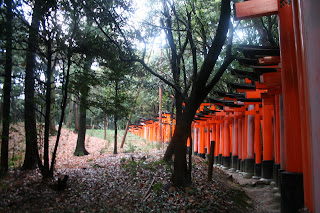

Kamakura - A former Buddhist stronghold (the atmosphere certainly reinforces it) in 10th century Japan, I decided, visiting with the family, that if I were to move to Japan permanently (very unlikely; just a hypothetical), Kamakura would be where I would like to base myself. Small yet varied; quiet but active; humble without cause.


Hakone - a popular hotsprings resort outside of Tokyo. The air was crisp, the winds lively. The closest I've been to pure paradise was sitting in a steaming hot bath outdoors - the extreme warmth underneath and extreme cold on top joined forces, melting away the tension stored in my joints and muscles. There's also a big mountain near there. Perhaps you've heard of it - Fuji.


Hiroshima - I was a bit nervous about Hiroshima. It felt wrong initially, hopping on a street car, camera in hand, going to the spot where my country cause untold amounts of human suffering, so much so that the city's name alone is a synonym for the deadliest of human ingenuities. The A-Bomb dome, a building whose frame survived despite being a few hundred meters below the site of the explosion, was, for locals, just another train stop. If my time there (just 24 hours) proved to me anything at all, I suppose it was that even the remnants of the atomic bomb can become just another tourist attraction with the passing of time.


Kyoto - This was a bit of a homecoming for me. Kyoto is the city where I spent my first weeks in Japan in 2005, so most of the sights reminded me of the time when I became determined to spend my year abroad here. It was as pretty as I remember it to be. Temples, shrines, a quiet walk along the Philosopher's Path, pensive amid a light drizzle.


Kamakura - A former Buddhist stronghold (the atmosphere certainly reinforces it) in 10th century Japan, I decided, visiting with the family, that if I were to move to Japan permanently (very unlikely; just a hypothetical), Kamakura would be where I would like to base myself. Small yet varied; quiet but active; humble without cause.


Coming of Age (Again)
The national holidays of Japan consist of an odd mix of nationalist (the Emperor’s birthday), religious (Buddha’s birthday), pseudo-pagan (the autumn and spring equinoxes) and kind of cute (Respect for the Elderly Day, popularly known as Old Folks’ Day) observances. Save for New Year’s, I’ve yet to really feel a part in the observance of these holidays (I’m not elderly, or the Emperor, or Buddha), but last Monday’s holiday changed all of that.
The second Monday in January is Coming-of-Age day, where everyone who turned 20 during the preceding year gathers in public spaces and enjoys a ceremony marking their entrance into adulthood. This was very exciting news, because I am 20, and by all accounts there was to be a ceremony at the local city hall for all the 20-year olds in the city. I delicately asked the student affairs director at the university about it, and she managed to push a few buttons and get me an invitation.
Of course, the problem here is that I’ve already had a coming-of-age ceremony – my Bar Mitzvah. Whether or not this disqualified me from coming of age a second time (I didn’t tell anybody, just to be safe), it struck me as odd that two cultures ended up seven years apart in their estimation of when a person becomes an adult, what with a pool of only 20 years to choose from in the first place. Of course, none of this could stop me from donning a shirt and tie for the first time in months, hopping on the bike and riding to my Japanese Bar Mitzvah.
A few points really distinguished this ceremony from my Bar Mitzvah nearly eight years ago. To begin with, in lieu of the synagogue I grew up in, filled with family members and close friends, mostly Jewish, my Japanese coming-of-age took place in an enormous hall filled with about 600 Japanese twenty-year olds and one non-Japanese person (me). Instead of shirts, ties and skirts, the majority crowd was in kimonos and other traditional dress, although a fair number of the males were dressed in suits and had that pan-cultural “If it was up to me, I wouldn’t be wearing this” look on their faces.
The only similarity I could really think of was that at both ceremonies I was constantly being congratulated by old people whom I’d never met before.
As I found a seat, the lights dimmed and the curtain rose, revealing two lines of five seats filled with important people whose exact titles escape me. A few of these people went up to the podium, bowed down to their ankles, and then bowed to each row of people seated on the stage, who bowed from their seats in unison, like a crew team slowly moving forward against a current. They all praised Mitaka (the section of Tokyo I live in), wished everyone a kokoro kara omedetou gozaimasu (heartfelt congratulations) implored us (not me, I deduced) to vote, and passed the microphone to the next speaker. As is usually the case at ceremonies in Japan, the crowd was fairly talkative throughout.
Upon the conclusion of these welcome speeches, two males, probably local high school or college students (they received numerous “woo!”s from the crowd), informed us that we were about to view a performance (the program read “Performance”), so would we please all stop talking and be respectful. The white noise of scattered chatter slowly dissipated into a whisper, and once again the lights dimmed.
As soon as the silence had become whole, a thick baseline erupted from the speakers hanging on either side of the stage, and four youths dressed in matching black tracksuits galloped on stage and began a very specifically choreographed hip-hop dance routine to music containing the only English heard that day (variations on “Let’s dance,” and other passages directed at a girl with whom the singer would prefer to be physically closer). There was much gesticulation and gyration in the direction of the audience, and just to make sure nothing had been lost in translation, I double-checked with the girl sitting next to me (wearing a kimono and hairdo which had taken 3 ½ hours to put together, so she said) that there was indeed no relevant connection between this performance and the rest of the ceremony. After their performance was over, and the group stood in a line breathing heavily and bowing, their leader forwarded us a very formal congratulation from the group and exited stage right.
At about this time my neighbor became interested in my presence (she saw that I had a cell phone), and we exchanged the traditional greetings between a Japanese person and a foreigner (Your Japanese is really good! – No, it’s not – It really is! – It’s really not [when someone compliments you, its considered a little boastful to say “thank you, so you’re supposed to brush away the compliment]), and she told me that she likes Americans and Europeans because they’re tall and have blue eyes (oh, well), and did I know her friend who goes to my school (no). Her friends, sitting behind us, started making fun of her because she was talking to the foreigner. I turned around and introduced myself in Japanese, and they stopped making fun.
In the middle of our fourth or fifth exchange of “Your Japanese Is Really Good – No It’s Not,” the lights dimmed again, this time for a slideshow that went through each year of the attendees lives (1987-2007), showing a one or two pictures that detailed the big events of that particular year, set to cheery pop music. Here’s a sampling:
1995: the Kobe earthquake (6500 killed, $200 billion in damage, a major city uprooted by mother nature); Tokyo Subway Gas Attacks (an act of terror in the public transportation system of the largest city in the world)
1998: Ichiro breaks the Japanese League hits record
2001: World Trade Center attacks
2003: Hideki Matsui comes to play for the Yankees
2007: Billy Blanks*
*(Billy Blanks [of Tae-Bo fame] is HUGE in Japan. Walk into most department stores and you hear his videos being shown in the background. I really really really wish I were making this up. But I’m not.)
I haven’t the data to back this up, but I’m pretty sure that this is the first time that 9/11, Ichiro and Billy Blanks have appeared in the same presentation. Again, my neighbor was unfazed. I was too confused to request an explanation.
To conclude the ceremony, we stood sang Tabidachi no hi ni (On the Day Your Journey Begins), which is to Japanese graduation-type ceremonies what “I Believe I Can Fly” and that “Time of Your Life” song are to American graduation-type ceremonies. The lyrics were printed on the ceremony program, so I tried to sing along a little bit (You read Japanese so well! – No I don’t), and though I lost the tune a few times, I was able to follow.
There, singing together with about 600 complete strangers a song whose meaning I could only feel through the melody, I felt an unusual sense of belonging. Most of the time, I feel adrift in Tokyo – I don’t belong to the Japanese, and the foreign community is, in general, a scattered one. But standing in that hall, lending a voice – nationality indistinguishable - to the group, I felt, however fleetingly, that I was no longer just a visitor; after all the months of viewing their culture from the outside, I had found this hidden avenue to the inside, and, wrapped in the evanescence of melody, nobody seemed to mind letting me in. I wasn’t a foreigner; I felt I was a natural part of the whole.
The feeling lasted just a brief few moments, but that small glimpse of being just one of the crowd was clear enough to convince me that I had arrived at some sort of destination. By no means did I feel like had just begun or finally completed a journey, but somewhere in between confusion and understanding, singing words that I could only vaguely define with people I would never meet again, I came of age in a way that had nothing to do with getting older.
The second Monday in January is Coming-of-Age day, where everyone who turned 20 during the preceding year gathers in public spaces and enjoys a ceremony marking their entrance into adulthood. This was very exciting news, because I am 20, and by all accounts there was to be a ceremony at the local city hall for all the 20-year olds in the city. I delicately asked the student affairs director at the university about it, and she managed to push a few buttons and get me an invitation.
Of course, the problem here is that I’ve already had a coming-of-age ceremony – my Bar Mitzvah. Whether or not this disqualified me from coming of age a second time (I didn’t tell anybody, just to be safe), it struck me as odd that two cultures ended up seven years apart in their estimation of when a person becomes an adult, what with a pool of only 20 years to choose from in the first place. Of course, none of this could stop me from donning a shirt and tie for the first time in months, hopping on the bike and riding to my Japanese Bar Mitzvah.
A few points really distinguished this ceremony from my Bar Mitzvah nearly eight years ago. To begin with, in lieu of the synagogue I grew up in, filled with family members and close friends, mostly Jewish, my Japanese coming-of-age took place in an enormous hall filled with about 600 Japanese twenty-year olds and one non-Japanese person (me). Instead of shirts, ties and skirts, the majority crowd was in kimonos and other traditional dress, although a fair number of the males were dressed in suits and had that pan-cultural “If it was up to me, I wouldn’t be wearing this” look on their faces.
The only similarity I could really think of was that at both ceremonies I was constantly being congratulated by old people whom I’d never met before.
As I found a seat, the lights dimmed and the curtain rose, revealing two lines of five seats filled with important people whose exact titles escape me. A few of these people went up to the podium, bowed down to their ankles, and then bowed to each row of people seated on the stage, who bowed from their seats in unison, like a crew team slowly moving forward against a current. They all praised Mitaka (the section of Tokyo I live in), wished everyone a kokoro kara omedetou gozaimasu (heartfelt congratulations) implored us (not me, I deduced) to vote, and passed the microphone to the next speaker. As is usually the case at ceremonies in Japan, the crowd was fairly talkative throughout.
Upon the conclusion of these welcome speeches, two males, probably local high school or college students (they received numerous “woo!”s from the crowd), informed us that we were about to view a performance (the program read “Performance”), so would we please all stop talking and be respectful. The white noise of scattered chatter slowly dissipated into a whisper, and once again the lights dimmed.
As soon as the silence had become whole, a thick baseline erupted from the speakers hanging on either side of the stage, and four youths dressed in matching black tracksuits galloped on stage and began a very specifically choreographed hip-hop dance routine to music containing the only English heard that day (variations on “Let’s dance,” and other passages directed at a girl with whom the singer would prefer to be physically closer). There was much gesticulation and gyration in the direction of the audience, and just to make sure nothing had been lost in translation, I double-checked with the girl sitting next to me (wearing a kimono and hairdo which had taken 3 ½ hours to put together, so she said) that there was indeed no relevant connection between this performance and the rest of the ceremony. After their performance was over, and the group stood in a line breathing heavily and bowing, their leader forwarded us a very formal congratulation from the group and exited stage right.
At about this time my neighbor became interested in my presence (she saw that I had a cell phone), and we exchanged the traditional greetings between a Japanese person and a foreigner (Your Japanese is really good! – No, it’s not – It really is! – It’s really not [when someone compliments you, its considered a little boastful to say “thank you, so you’re supposed to brush away the compliment]), and she told me that she likes Americans and Europeans because they’re tall and have blue eyes (oh, well), and did I know her friend who goes to my school (no). Her friends, sitting behind us, started making fun of her because she was talking to the foreigner. I turned around and introduced myself in Japanese, and they stopped making fun.
In the middle of our fourth or fifth exchange of “Your Japanese Is Really Good – No It’s Not,” the lights dimmed again, this time for a slideshow that went through each year of the attendees lives (1987-2007), showing a one or two pictures that detailed the big events of that particular year, set to cheery pop music. Here’s a sampling:
1995: the Kobe earthquake (6500 killed, $200 billion in damage, a major city uprooted by mother nature); Tokyo Subway Gas Attacks (an act of terror in the public transportation system of the largest city in the world)
1998: Ichiro breaks the Japanese League hits record
2001: World Trade Center attacks
2003: Hideki Matsui comes to play for the Yankees
2007: Billy Blanks*
*(Billy Blanks [of Tae-Bo fame] is HUGE in Japan. Walk into most department stores and you hear his videos being shown in the background. I really really really wish I were making this up. But I’m not.)
I haven’t the data to back this up, but I’m pretty sure that this is the first time that 9/11, Ichiro and Billy Blanks have appeared in the same presentation. Again, my neighbor was unfazed. I was too confused to request an explanation.
To conclude the ceremony, we stood sang Tabidachi no hi ni (On the Day Your Journey Begins), which is to Japanese graduation-type ceremonies what “I Believe I Can Fly” and that “Time of Your Life” song are to American graduation-type ceremonies. The lyrics were printed on the ceremony program, so I tried to sing along a little bit (You read Japanese so well! – No I don’t), and though I lost the tune a few times, I was able to follow.
There, singing together with about 600 complete strangers a song whose meaning I could only feel through the melody, I felt an unusual sense of belonging. Most of the time, I feel adrift in Tokyo – I don’t belong to the Japanese, and the foreign community is, in general, a scattered one. But standing in that hall, lending a voice – nationality indistinguishable - to the group, I felt, however fleetingly, that I was no longer just a visitor; after all the months of viewing their culture from the outside, I had found this hidden avenue to the inside, and, wrapped in the evanescence of melody, nobody seemed to mind letting me in. I wasn’t a foreigner; I felt I was a natural part of the whole.
The feeling lasted just a brief few moments, but that small glimpse of being just one of the crowd was clear enough to convince me that I had arrived at some sort of destination. By no means did I feel like had just begun or finally completed a journey, but somewhere in between confusion and understanding, singing words that I could only vaguely define with people I would never meet again, I came of age in a way that had nothing to do with getting older.
Sunday, January 6, 2008
O-matase shimaimashita
(First, a note on the subject of the post. At any store in Japan, if you are kept waiting for any period of time longer than nothing, before paying for or receiving something you ordered, the clerk or applicable body will say a heartfelt [or sometimes not so heartfelt] o-mataseshimaimashita, which is an untranslatably polite phrase that means, sort of, “I have shamelessly and undeservedly made you wait.” In Japan, a country with, in general, very little sense of irony, this phrase is said at points even when it’s obvious that a) there was no choice but to make someone wait, or b) the time spent waiting was approximately 1.37 seconds. So, because I feel that it’s been far too long since I’ve written, I wanted to say to all of you o-mataseshimaimashita; it won’t happen again.
In an unrelated note, whenever I’m with a Japanese friend and I have to tie my shoe or run back inside to get something, I come back and say to them o-mataseshimaimashita. They are never terribly amused by it, but I think it’s really funny every time. Okay, onto the actual post.)
Besides the obvious, I think that a lot can be learned from a language textbook. Gauging the category of vocabulary learned early on, the examples of discussion and role-play situations, a student can learn not only some new words but, in general, what cultural attitudes and experiences go along with speaking this new language. For example, in the Hebrew textbook I used, the situations given for conversation practice usually included arguing over prices at the local market, telling someone they were crazy, or lamenting the situation of the world-at-large in a uniquely enchanting Israeli way.
The authors of that textbook were correct (in my opinion) that the situations often encountered in Israel, where one will probably end up speaking Hebrew, usually revolve around arguing and passionate displays of emotion and opinion. It makes sense – prepare the students for the real-world situations they’re most likely to experience as speakers of the language.
So I think it’s safe to conclude that the context in which a language is taught provides a lot of implicit information about the culture.
Consider, then, the Japanese language textbook. Almost invariably, the situations described in Japanese textbooks involve a confused foreigner trying to figure out Japanese culture. Almost never are a Japanese and an American talking like normal friends, and almost invisible is the foreign student with a deeper understanding of Japanese culture.
For example, two weeks of class based on an essay written by a Japanese person bemoaning the lack of proper thanks given by an American he took care of. The American thanked him once and not again; the author could not understand how someone could stop after just one thank you. Roles for discussion are often given that include an average Japanese explaining a particular custom to a baffled foreigner, and popular essay topics include how Japan is different from home, what shocked one about Japan upon first arriving, and the difficulties of learning the language.
I know that much of this is out of consideration and politeness, and they certainly don’t have to go out of their way to help foreigners out, but if we compare the Hebrew and Japanese textbook models, it would be hard not to conclude that the expected situation for a student of Japanese in Japan is utter confusion. It certainly seems, based on all of this and my own personal experience, that I’m expected to not have any idea what’s going on around me.
It often feels like this kind of attitude is designed to keep reminding me that I’m an outsider, though I simply need to walk outside for that reminder anyway. The truth is that not much shocked me when I first arrived here – I had been to Japan before, taken a class on Japanese history and read enough Japanese literature to have at least a vague grasp on its collective unconscious. Does this make me an expert? Of course not, but with the world shrinking every moment, few people come to Tokyo without some sort of knowledge of Japan, its history, and its customs.
Yet the image of the confused foreigner continues to be promulgated. This isn’t to say I understand what’s going on – what I don’t get could fill multiple encyclopedia sets – but nearly four months into my time here, I’m ready to shed the image.
In fact, I may have to. This week I’m playing host for the first time – at first to a Japanese friend from Kyoto (I will show him around Tokyo, in a strange twist of roles), and then to my parents and youngest brother. With the job as host comes a certain feeling of ownership of one’s surroundings, and I’m enjoying it even before my visitors come. In the face of the expectation of being overwhelmed, I will show people around, tell them which trains to take, walk to new places without a map, serve as translator, and try to share my love for this incredible city.
The thought has come to me more than once that perhaps it is the locals who are overwhelmed by my presence, and that the confusion they expect me to have is in part their confusion as to where I fit in their society. Many times I feel that, when I go to a place where foreigners aren’t expected to go, the locals don’t know what to do with me. They certainly seemed as baffled, if not more so, than the foreign characters in my textbook.
The other day I went to buy a pillow and sheets for my guest coming on Friday. Outside the store, an older man saw me and said, proudly flaunting his English ability, “Shopping visit?” I answered in Japanese and we had a nice little conversation about where I lived, what I was doing in Tokyo, and other things like that. As we were about to part, he said, smiling and grandfatherly, “Be careful!”*
“But Japan is really safe, isn’t it?” I answered jokingly.
Turning away from me, he mounted his bike. “Be careful,” he said quietly in English, as if to himself.
*I feel I must clarify. The phrase he used is "ki o tsukete," which is kind of a cross between "take care" and "be careful," but I think it can be translated either way. I hope, anyway.
In an unrelated note, whenever I’m with a Japanese friend and I have to tie my shoe or run back inside to get something, I come back and say to them o-mataseshimaimashita. They are never terribly amused by it, but I think it’s really funny every time. Okay, onto the actual post.)
Besides the obvious, I think that a lot can be learned from a language textbook. Gauging the category of vocabulary learned early on, the examples of discussion and role-play situations, a student can learn not only some new words but, in general, what cultural attitudes and experiences go along with speaking this new language. For example, in the Hebrew textbook I used, the situations given for conversation practice usually included arguing over prices at the local market, telling someone they were crazy, or lamenting the situation of the world-at-large in a uniquely enchanting Israeli way.
The authors of that textbook were correct (in my opinion) that the situations often encountered in Israel, where one will probably end up speaking Hebrew, usually revolve around arguing and passionate displays of emotion and opinion. It makes sense – prepare the students for the real-world situations they’re most likely to experience as speakers of the language.
So I think it’s safe to conclude that the context in which a language is taught provides a lot of implicit information about the culture.
Consider, then, the Japanese language textbook. Almost invariably, the situations described in Japanese textbooks involve a confused foreigner trying to figure out Japanese culture. Almost never are a Japanese and an American talking like normal friends, and almost invisible is the foreign student with a deeper understanding of Japanese culture.
For example, two weeks of class based on an essay written by a Japanese person bemoaning the lack of proper thanks given by an American he took care of. The American thanked him once and not again; the author could not understand how someone could stop after just one thank you. Roles for discussion are often given that include an average Japanese explaining a particular custom to a baffled foreigner, and popular essay topics include how Japan is different from home, what shocked one about Japan upon first arriving, and the difficulties of learning the language.
I know that much of this is out of consideration and politeness, and they certainly don’t have to go out of their way to help foreigners out, but if we compare the Hebrew and Japanese textbook models, it would be hard not to conclude that the expected situation for a student of Japanese in Japan is utter confusion. It certainly seems, based on all of this and my own personal experience, that I’m expected to not have any idea what’s going on around me.
It often feels like this kind of attitude is designed to keep reminding me that I’m an outsider, though I simply need to walk outside for that reminder anyway. The truth is that not much shocked me when I first arrived here – I had been to Japan before, taken a class on Japanese history and read enough Japanese literature to have at least a vague grasp on its collective unconscious. Does this make me an expert? Of course not, but with the world shrinking every moment, few people come to Tokyo without some sort of knowledge of Japan, its history, and its customs.
Yet the image of the confused foreigner continues to be promulgated. This isn’t to say I understand what’s going on – what I don’t get could fill multiple encyclopedia sets – but nearly four months into my time here, I’m ready to shed the image.
In fact, I may have to. This week I’m playing host for the first time – at first to a Japanese friend from Kyoto (I will show him around Tokyo, in a strange twist of roles), and then to my parents and youngest brother. With the job as host comes a certain feeling of ownership of one’s surroundings, and I’m enjoying it even before my visitors come. In the face of the expectation of being overwhelmed, I will show people around, tell them which trains to take, walk to new places without a map, serve as translator, and try to share my love for this incredible city.
The thought has come to me more than once that perhaps it is the locals who are overwhelmed by my presence, and that the confusion they expect me to have is in part their confusion as to where I fit in their society. Many times I feel that, when I go to a place where foreigners aren’t expected to go, the locals don’t know what to do with me. They certainly seemed as baffled, if not more so, than the foreign characters in my textbook.
The other day I went to buy a pillow and sheets for my guest coming on Friday. Outside the store, an older man saw me and said, proudly flaunting his English ability, “Shopping visit?” I answered in Japanese and we had a nice little conversation about where I lived, what I was doing in Tokyo, and other things like that. As we were about to part, he said, smiling and grandfatherly, “Be careful!”*
“But Japan is really safe, isn’t it?” I answered jokingly.
Turning away from me, he mounted his bike. “Be careful,” he said quietly in English, as if to himself.
*I feel I must clarify. The phrase he used is "ki o tsukete," which is kind of a cross between "take care" and "be careful," but I think it can be translated either way. I hope, anyway.
Monday, December 10, 2007
A Week in Hong Kong
I know that including an entry on Hong Kong kind of damages the accuracy of the title of the page, but I think we’ll all agree that “A Year in Tokyo” is catchier than “A Year in Tokyo [including five days in Hong Kong and a day in Macau],” which for that matter wouldn’t be correct either (half-day in Yokohama, etc etc), but to keep things easy I’ll keep it how it is, although it would not surprise me, given the size of Tokyo, that it extended to Hong Kong in some way or another, if not now then sooner or later.
A little historical context: Hong Kong was an English colony from 1842 until 1997, when a “transfer of its sovereignty,” a kind of purposely vague term, to China occurred. Whole books have been written about why it was transferred (I saw one in the bookstore yesterday), but the end result is that Hong Kong is both part of China and not, and theirs remains a very complicated political relationship. Unlike mainland China (Beijing, etc), a traveler doesn’t need a special visa to enter, as it operates its own immigration policies.
If European capitols are cities of the past, and Tokyo and other big Asian cities hosts to the past and future meeting, then Hong Kong is most definitely a city of the future. The first thing that struck me was how foolproof their transportation system is – it’s nearly impossible to go in the wrong direction. The streets of downtown are connected via a labyrinthine system of overpasses and underground walkways, and each subway station seemed to have so many entrances that it would be harder not to find one than to get lost.
Of course, the main attraction in Hong Kong, is the city-of-the-future look of its skyline, where this incredible system of transport weaves in and out like ivy.


It seemed the entire city was on its way to a meeting with a high-profile client that would push Hong Kong’s economy even further. Well-dressed businessmen dominated the landscape, shoulder to shoulder with both each other, eyes down cell phones open, and wide-eyed tourists trying to find the point at which the skyscrapers ended (they don’t).
The skyscrapers literally had no end – as my dad and I walked further up the central hill on which Hong Kong is built, each building, whether it residential or commercial, rose 40 stories above the ground as if it were no height at all. Closer to the bay, expensive brand names and western-style hotels were the norm, and each corner turned revealed another shopping center with stores familiar to buyers the world over. Further up the hill, Hong Kong’s Chinese side slowly revealed itself – the ubiquitous small restaurant with the roasted duck hanging in the window, red lanterns hanging lazily outside rundown bars, dimly lit fruit and vegetable stalls, and dusty old storefronts selling electronics, souvenirs, and everything else.
In Hong Kong city:
Hong Kong Park

Incense coils and candle at Man-Mo Temple, the oldest in Hong Kong. They celebrate the God of Literature there - needless to say I had to get one. There's a sticker on the bottom that says "Blessed."


Hong Kong Flower Market

Yuen Po Bird Market. This was kind of heartbreaking, seeing all these beautiful birds in cages.

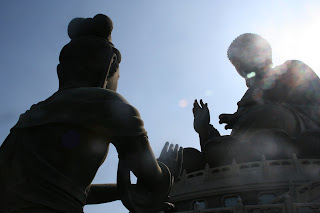
One gets the feeling, exploring downtown Hong Kong, that there is more to the area than that. Hong Kong’s largest island, Lantau, a ferry ride away, revealed rural areas that seemed miles and centuries away from the shiny capitalism of downtown. A long bus ride that seemed to ascend and descend the same mountain every few minutes lead us to Po-Lin Monastery, home to the largest outdoor Buddha in the world (who knew?) and, to my surprise and delight, a vegetarian cafeteria (quite the rarity in Tokyo). It was wonderfully peaceful, and even the presence of a largish bus terminal right in front of the monastery wasn’t enough to diminish the feeling of entering a sacred space.



A 15-minute walk away from the main monastery revealed the Wisdom Path. In the shape of the symbol for infinity, the path is surrounded by 38 halved tree trunks, on which are written passages from the Heart Sutra, a sacred document in Mahāyāna Buddhism.


Our second-to-last day in Hong Kong took us to the very north of the territory. Our destination was the Hong Kong Wetlands Park, a vast nature reserve on the border with China proper. The New Territories, as the area is called (it was the last section of Hong Kong to be incorporated), is home to both half of the population of Hong Kong (about 3.3 million), and new government subsidized housing projects for the built in order to maintain their stability as its likely future economic hope. These housing projects were awe-inspiring. Like downtown, each building was over 40 stories tall, and they literally went on for miles. The buildings were organized into single areas, each of which had a separate name. Each of these areas had their own grocery store, train station (explained later), play areas and other amenities. We saw many kids running about and giving us \ looks (we hardly saw another foreign-looking face).
The reason for this is probably because the Wetlands Park is so far away. We took a commuter railway out to one of the final stops on the line. Each of the stations on this line was nearly empty, spotlessly clean and utterly state-of-the-art. There clearly had been a large movement recently to increase the access of those living out in the New Territories to Hong Kong city. We hopped on what is called the Light Rail, which consisted of one little train filled mostly with young kids, old folks and the like. This train wound its way around all of these monstrous housing projects and stopped near every one.
This area struck a chord in me much more so than the Emerald City-esque city skyline. While exploring that area, I was struck by the feeling that although it seemed all-encompassing, there had to be a segment of the population of Hong Kong whose lives in no way related to the high-stakes business going on downtown. I believe we found it in the New Territories. It wasn’t desolate, nor did it seem crime-ridden or like an inner city at all. It seemed quite organized and the faces I saw did not appear to be those living in dire situations.
For me at least, what was overwhelming was seeing this endless skyline of apartment buildings and trying to picture the mass of people who lived there. Thousands of people living here, in such close quarters, in identical buildings in a community that looked exactly the same as the one next to it. It was humbling and made me feel quite small, especially since in the background of any view in the wetland park (which was quite beautiful), these buildings dominated the view. I doubted those who looked at the park from their small rooms on the 34th floor of a nameless building cared how many acres they had saved, or how many birds could now fly free.
The view looking south...

and the view looking north.

A common side trip for visitors to Hong Kong is to the nearby dependency of Macau. Macau was a colony of Portugal but, like Hong Kong, its sovereignty was transferred to China in the late 90s. It remains capitalistic, but unlike Hong Kong, it exuded a more provincial, laid-back feel. Although newly built-up sections of Macau are becoming indistinguishable from Las Vegas and other gambling hotspots, in the old sections colorful old colonial buildings dotted the landscape in between dilapidating apartment buildings and shops selling second- and third-hand goods.
From a chapel crowning the highest point on Macau, we peered at China proper lurking mysteriously in the distance, and walked around the small peninsula on the withered cobblestone walkway. Away from the glitz of the casinos and central tourist areas, Macau seemed tired. Our last stop, the A-Ma Temple, was a fog of incense that acted as a veil, an Oriental fog that clung to the skin like a sweet memory. Wrapped in dust, the sun set.
All of the street signs were in both Portugese and Cantonese. I took 7,000 pictures of them.

The Ruins of St. John's church, from the 16th century sometime, an important site for Asian Christians.

Colonial colors and styles.


A-Ma Temple


As is my tendency even when the occasion doesn’t call for it, I attempted to place my trip to Hong Kong in the context of my greater year abroad. Aside from the actual sightseeing, eating (the food, Chinese and otherwise, was fantastic) and photography, all of which opportunities were better than I could have hoped, this trip to me served as an extended meditation on the meaning of “home.”
Waiting for the elevator in the hotel one morning, a Japanese woman noticed that I was only wearing a t-shirt and, rubbing her arms to make the universal symbol for cold, asked me in Japanese if I wasn’t cold? I responded to her, No no, I’m fine, and she nearly fell over with surprise that I spoke the language.
Why is this relevant? This has never happened to me in Tokyo, that a random Japanese has talked to me in such a harmless manner. She undoubtedly talked to me because, in her mind, there was no way I could respond – in the same way that people sometimes tell deep secrets to people they have met once and will never meet again, secrets they haven’t told even their closest confidants.
Being out of one’s element is both a scary and liberating experience, and I suppose that I’ve gotten used to having that duality in my everyday life. In Hong Kong, when I looked at a menu in English for the first time in months, I felt like I was cheating on an important test. The ease with which I read all the signs in English unnerved me – I actually longed for the challenge of having very little available in English, and for the feeling of accomplishment that wells up inside me when I learn a certain word and can finally understand a sign I’ve seen so many times before.
As I walked through the airport back in Tokyo, I felt once again at home, but in a different sense than I would have expected. I count four cities in which I’ve lived in the past seven months, so I suppose I’m used to uprooting myself as of late. Although Japan is still a riddle I’ve yet to solve, I’ve realized that I’ve become comfortable not knowing the answer. I’m never going to “look” like I belong in Tokyo, but if that had been the goal in the first place, I wouldn’t have felt so wonderful when, upon returning home, I saw that my apartment was just the way I had left it.
A little historical context: Hong Kong was an English colony from 1842 until 1997, when a “transfer of its sovereignty,” a kind of purposely vague term, to China occurred. Whole books have been written about why it was transferred (I saw one in the bookstore yesterday), but the end result is that Hong Kong is both part of China and not, and theirs remains a very complicated political relationship. Unlike mainland China (Beijing, etc), a traveler doesn’t need a special visa to enter, as it operates its own immigration policies.
If European capitols are cities of the past, and Tokyo and other big Asian cities hosts to the past and future meeting, then Hong Kong is most definitely a city of the future. The first thing that struck me was how foolproof their transportation system is – it’s nearly impossible to go in the wrong direction. The streets of downtown are connected via a labyrinthine system of overpasses and underground walkways, and each subway station seemed to have so many entrances that it would be harder not to find one than to get lost.
Of course, the main attraction in Hong Kong, is the city-of-the-future look of its skyline, where this incredible system of transport weaves in and out like ivy.


It seemed the entire city was on its way to a meeting with a high-profile client that would push Hong Kong’s economy even further. Well-dressed businessmen dominated the landscape, shoulder to shoulder with both each other, eyes down cell phones open, and wide-eyed tourists trying to find the point at which the skyscrapers ended (they don’t).
The skyscrapers literally had no end – as my dad and I walked further up the central hill on which Hong Kong is built, each building, whether it residential or commercial, rose 40 stories above the ground as if it were no height at all. Closer to the bay, expensive brand names and western-style hotels were the norm, and each corner turned revealed another shopping center with stores familiar to buyers the world over. Further up the hill, Hong Kong’s Chinese side slowly revealed itself – the ubiquitous small restaurant with the roasted duck hanging in the window, red lanterns hanging lazily outside rundown bars, dimly lit fruit and vegetable stalls, and dusty old storefronts selling electronics, souvenirs, and everything else.
In Hong Kong city:
Hong Kong Park

Incense coils and candle at Man-Mo Temple, the oldest in Hong Kong. They celebrate the God of Literature there - needless to say I had to get one. There's a sticker on the bottom that says "Blessed."


Hong Kong Flower Market

Yuen Po Bird Market. This was kind of heartbreaking, seeing all these beautiful birds in cages.

One gets the feeling, exploring downtown Hong Kong, that there is more to the area than that. Hong Kong’s largest island, Lantau, a ferry ride away, revealed rural areas that seemed miles and centuries away from the shiny capitalism of downtown. A long bus ride that seemed to ascend and descend the same mountain every few minutes lead us to Po-Lin Monastery, home to the largest outdoor Buddha in the world (who knew?) and, to my surprise and delight, a vegetarian cafeteria (quite the rarity in Tokyo). It was wonderfully peaceful, and even the presence of a largish bus terminal right in front of the monastery wasn’t enough to diminish the feeling of entering a sacred space.


A 15-minute walk away from the main monastery revealed the Wisdom Path. In the shape of the symbol for infinity, the path is surrounded by 38 halved tree trunks, on which are written passages from the Heart Sutra, a sacred document in Mahāyāna Buddhism.


Our second-to-last day in Hong Kong took us to the very north of the territory. Our destination was the Hong Kong Wetlands Park, a vast nature reserve on the border with China proper. The New Territories, as the area is called (it was the last section of Hong Kong to be incorporated), is home to both half of the population of Hong Kong (about 3.3 million), and new government subsidized housing projects for the built in order to maintain their stability as its likely future economic hope. These housing projects were awe-inspiring. Like downtown, each building was over 40 stories tall, and they literally went on for miles. The buildings were organized into single areas, each of which had a separate name. Each of these areas had their own grocery store, train station (explained later), play areas and other amenities. We saw many kids running about and giving us \ looks (we hardly saw another foreign-looking face).
The reason for this is probably because the Wetlands Park is so far away. We took a commuter railway out to one of the final stops on the line. Each of the stations on this line was nearly empty, spotlessly clean and utterly state-of-the-art. There clearly had been a large movement recently to increase the access of those living out in the New Territories to Hong Kong city. We hopped on what is called the Light Rail, which consisted of one little train filled mostly with young kids, old folks and the like. This train wound its way around all of these monstrous housing projects and stopped near every one.
This area struck a chord in me much more so than the Emerald City-esque city skyline. While exploring that area, I was struck by the feeling that although it seemed all-encompassing, there had to be a segment of the population of Hong Kong whose lives in no way related to the high-stakes business going on downtown. I believe we found it in the New Territories. It wasn’t desolate, nor did it seem crime-ridden or like an inner city at all. It seemed quite organized and the faces I saw did not appear to be those living in dire situations.
For me at least, what was overwhelming was seeing this endless skyline of apartment buildings and trying to picture the mass of people who lived there. Thousands of people living here, in such close quarters, in identical buildings in a community that looked exactly the same as the one next to it. It was humbling and made me feel quite small, especially since in the background of any view in the wetland park (which was quite beautiful), these buildings dominated the view. I doubted those who looked at the park from their small rooms on the 34th floor of a nameless building cared how many acres they had saved, or how many birds could now fly free.
The view looking south...

and the view looking north.

A common side trip for visitors to Hong Kong is to the nearby dependency of Macau. Macau was a colony of Portugal but, like Hong Kong, its sovereignty was transferred to China in the late 90s. It remains capitalistic, but unlike Hong Kong, it exuded a more provincial, laid-back feel. Although newly built-up sections of Macau are becoming indistinguishable from Las Vegas and other gambling hotspots, in the old sections colorful old colonial buildings dotted the landscape in between dilapidating apartment buildings and shops selling second- and third-hand goods.
From a chapel crowning the highest point on Macau, we peered at China proper lurking mysteriously in the distance, and walked around the small peninsula on the withered cobblestone walkway. Away from the glitz of the casinos and central tourist areas, Macau seemed tired. Our last stop, the A-Ma Temple, was a fog of incense that acted as a veil, an Oriental fog that clung to the skin like a sweet memory. Wrapped in dust, the sun set.
All of the street signs were in both Portugese and Cantonese. I took 7,000 pictures of them.

The Ruins of St. John's church, from the 16th century sometime, an important site for Asian Christians.

Colonial colors and styles.


A-Ma Temple


As is my tendency even when the occasion doesn’t call for it, I attempted to place my trip to Hong Kong in the context of my greater year abroad. Aside from the actual sightseeing, eating (the food, Chinese and otherwise, was fantastic) and photography, all of which opportunities were better than I could have hoped, this trip to me served as an extended meditation on the meaning of “home.”
Waiting for the elevator in the hotel one morning, a Japanese woman noticed that I was only wearing a t-shirt and, rubbing her arms to make the universal symbol for cold, asked me in Japanese if I wasn’t cold? I responded to her, No no, I’m fine, and she nearly fell over with surprise that I spoke the language.
Why is this relevant? This has never happened to me in Tokyo, that a random Japanese has talked to me in such a harmless manner. She undoubtedly talked to me because, in her mind, there was no way I could respond – in the same way that people sometimes tell deep secrets to people they have met once and will never meet again, secrets they haven’t told even their closest confidants.
Being out of one’s element is both a scary and liberating experience, and I suppose that I’ve gotten used to having that duality in my everyday life. In Hong Kong, when I looked at a menu in English for the first time in months, I felt like I was cheating on an important test. The ease with which I read all the signs in English unnerved me – I actually longed for the challenge of having very little available in English, and for the feeling of accomplishment that wells up inside me when I learn a certain word and can finally understand a sign I’ve seen so many times before.
As I walked through the airport back in Tokyo, I felt once again at home, but in a different sense than I would have expected. I count four cities in which I’ve lived in the past seven months, so I suppose I’m used to uprooting myself as of late. Although Japan is still a riddle I’ve yet to solve, I’ve realized that I’ve become comfortable not knowing the answer. I’m never going to “look” like I belong in Tokyo, but if that had been the goal in the first place, I wouldn’t have felt so wonderful when, upon returning home, I saw that my apartment was just the way I had left it.
Subscribe to:
Posts (Atom)