Japanese people are often amazed when they see foreigners surviving in Japan. Often they ask, "Are you able eat Japanese food?" which sometimes also is phrased as, "Do you like natto?" Natto tastes just like it looks, which is eeuwhhghghh, and the Japanese get a kick out of the fact that, though Westerners are quite good with most Japanese cuisine, natto is still out of our culinary reach.
When Westerners do show some skill in reading and speaking Japanese or eating Japanese cuisine, we are often complimented generously. For instance, I went into a bento (boxed lunch) shop, and told the lady behind the counter, "It all looks delicious."
Her face lit up like a prairie at sunrise. "Your Japanese is so good!" she cried.
I've also been praised for my ability to eat sushi, my talent for writing my name, and the language skills I possess for asking for the check at a restaurant.
Usually these comments are made in good humor, and it shows that they are trying to start a conversation with a safe topic in easy Japanese, and I really do appreciate it.
Yesterday, however, I received a compliment that I must say not only made all of my other worries dissipate, but reminded me that even though I may not write the next Great American Novel or win a Nobel Prize, sometimes it's the simplest things that matter most.
"My, my," said a kind woman who sat next to me on the counter at a little bar, watching me eat, "you are so good at using chopsticks!"
"Well," I said, turning towards her, in the coolest possible voice I could muster, "thank you."
Thursday, May 29, 2008

Saturday, May 24, 2008
Pale, Flabby Men Try to Push Each Other Out of A Circular Space. Comedy Ensues.
Friday was one of those very special, "I'm in Japan, there's no doubt," experiences. My friend Arthur and I went to see the 14th day of the summer Sumo tournament in Ryogoku, in eastern Tokyo, the axis on which the sumo world turns.
The atmosphere was phenomenal, and the anticipation, watching the two wreslters (rikishi) try to psyche each other out, playing mind games, was so thick you could pick it up with your chopsticks. As they lunged at each other, even in our seats up in the second deck (the stadium holds 11,000) we could hear the dull slap of flab on flab, as well as their bull-like grunting as they held each other in position, waiting for the other to crack, waiting for that open split second to make the winning move.
All three of the favorites lost, but the next day Kotooshu, a Bulgarian wrestler and the first European winner of a sumo tournament in history, claimed the tournament victory. Finally, a white male has his day in the limelight. One for tellin' the grandkids.


(Can you tell which ones are the wrestlers?)
The atmosphere was phenomenal, and the anticipation, watching the two wreslters (rikishi) try to psyche each other out, playing mind games, was so thick you could pick it up with your chopsticks. As they lunged at each other, even in our seats up in the second deck (the stadium holds 11,000) we could hear the dull slap of flab on flab, as well as their bull-like grunting as they held each other in position, waiting for the other to crack, waiting for that open split second to make the winning move.
All three of the favorites lost, but the next day Kotooshu, a Bulgarian wrestler and the first European winner of a sumo tournament in history, claimed the tournament victory. Finally, a white male has his day in the limelight. One for tellin' the grandkids.


(Can you tell which ones are the wrestlers?)
Tuesday, May 20, 2008
There's Nowhere to Eat Near Jiko-ji
The only place I’ve ever seen Jiko-ji written about is in one of the guidebooks on Tokyo sitting on my bookshelf. Buried in the back of the book, a few pages from the index, it appears in a section titled “Other Trips,” which itself is a sub-section of “Trips Out of Town,” which itself is a departure from the main focus of the book, which is Tokyo itself. The entry has no pictures or maps. Because Jiko-ji is located in rural Japan, where public transportation is sparse at best, the book suggests the traveler check train and bus schedules ahead of time, but gives no indication as to where to access that information. Under the heading, “Where to Eat,” it informs the reader, with or without irony I can’t tell, that, “There’s nowhere to eat near Jiko-ji.”
Jiko-ji’s (-ji is one of the suffixes in Japanese for a Buddhist temple) claim to apparently low-grade fame is that it is the oldest temple in the Kanto (Eastern Japan) region, thought to have been established in 673, eventually wielding its greatest influence in the 13th century. It’s in an area that’s not really near anything, and not on the way to anywhere, and even though they felt it was interesting enough to include in their publication, it seemed that the authors of the guidebook didn’t really expect anyone to actually go.
I transferred trains five times before arriving at tiny Myokaku Station, manned by a single old attendant who bowed to each passenger as they handed their tickets over. Only about four other people got off with me, all old enough to be my grandparents. In the parking lot was the bus I was going to take another few miles to get to the entrance of the temple. The driver sat outside of the bus smoking a cigarette, looking slightly overweight and sweaty in his uniform, and when he saw me approach he flicked the last embers into the bushes and climbed into the driver’s seat. I told him where I wanted to go and he handed me a transfer ticket – this bus didn’t go there, but at the last stop, if I got out and waited another ten minutes, another one would come to take me to the entrance.
The Japanese attitude towards religion challenges its Western counterpart – actually, you could even say it laughs at it. We in the West give ourselves completely over to our religions – we are Catholic, we are Jewish, and we behave and identify as such. By doing so, we also make clear that we are not anything else. If we go to the worship service of another religion, it’s just for the experience, we say - it doesn’t become our identity. It’s not possible to be Jewish on Saturday, go to a Sabbath service at a synagogue, and then go to Mass on Sunday and be Christian, and then have a clean religious slate once again on Monday. Changing religions is a long and official process, and one notifies friends and family, who often object, of the change.
The Japanese are often described as being Buddhist at birth, Christian at their wedding and Shinto (the native Japanese religion) when they die. If one were to judge strictly by the type of ceremonies they have at these life cycle events, this would be true. But, if you ask most Japanese, they will tell you that they are none of the above, though one doesn’t have to look terribly hard to find traces of Buddhist, Shinto and Confucian ideas in the Japanese perception of the world and of society. A Christian wedding to them is just that – a wedding. Just because you have one does not mean you are a Christian, you do not have to be Christian to have one in the first place.
The same can be said, then for visiting Buddhist temples and Shinto shrines, and their architecture confirms this. Unlike synagogues and chapels, which are indoor, private sanctuaries, temples and shrines are always outside, open to the world. Worship is done in public and is informal, always free form. You don’t need anybody’s permission to enter, you don’t need to be a member of either religion to pray, and nobody will ask you for anything when you leave.
I find solace in this idea, that one’s spiritual affiliation transcends dogma. In Japan, one can be Buddhist during the half hour they spend at a temple, then become Shinto when visiting the shrine next door – no long-term commitment is necessary. In both cases, some core energy is released that does not discriminate based on location – what is important is not by what means, but by what intent.
I was dropped off in the tiny village of Nishi-Daira, from where it was an hour’s walk up into the low-lying mountains, passing tiny wooden shrines and a few cemeteries on the way to the main building of Jiko-ji. Everything seemed swathed in a gentle light, and, in the absence of the cacophonous and never-ending background noise of Tokyo, the sounds of the birds chattering seemed artificially amplified. In between the trees, the expanse of stout, wide hills extended off into the distance, retreating into a dream-like haze towards horizon. The entrance to the temple, a narrow stairway that was encroached upon by the surrounding shrubs, suddenly appeared. Looking around, it seemed I was the only visitor that day.
Rural Japan, I have come to realize, is not the place to go if you are feeling paranoid, mainly because everyone who you would perceive to be looking at you and whispering to their friend about you probably is looking at you and whispering to their friend about you. For a long time, this sequence of events never failed to rattle me, not only because of my dislike for the running assumption in Japan that foreigners don’t know enough Japanese to figure out that they are being talked about, but mainly because it was the first time in my life that I was so aware that I was a white person.
Recently, though, I’ve been invigorated by these feelings. As I got further into rural areas on the way to Jiko-ji, as the trains I took became smaller and older, and the dress of those traveling more conservative and the stations more windswept, more eyes wandered my way. On one train, three young schoolgirls stood around the empty spot next to me, looking back and forth between the open seat and me, each offering it to the others, trying not to make it obvious that none of them really wanted to sit next to me. Early in my time here this would have bothered me to no end, but on this day it made me feel undoubtedly alive, as if it were a confirmation of what I thought myself to be, a sign that I was somewhere where I could create cultural and mental sparks, tension, and friction by simply being there, a simultaneous feeling of experiencing of the “other” and being “other” itself.
I climbed the steep stairway that leads to the main hall of the temple. It was almost gothic in stature, tall and dark and complexly built, even more so against the background of gentle forest green. A few sticks of incense that must have been put there that morning lay used up in the altar. Even though nobody was around, I felt embarrassed that I didn’t know the absolutely correct procedure for praying, and I made doubly sure that nobody was coming up the stairs or from the pathway veering back to the main road. I threw in an offering and clapped my hands twice, one of the few rituals I’m familiar with. Birds chirped. A fly buzzed past my ear. I bowed my head and tried to clear my mind.
From the roof, a multi-colored rope hung down attached to a bell that the worshipper is supposed to ring before and after praying. Three times I rang. Each time, the bell emitted a soft, dusty groan that was quickly enveloped by the surrounding silence. Alone on a holy mountaintop, it sounded like everything at once and nothing at all.

On the way Up


Entrance and main hall of Jiko-ji

Myokaku station on the Hachiko Line
Jiko-ji’s (-ji is one of the suffixes in Japanese for a Buddhist temple) claim to apparently low-grade fame is that it is the oldest temple in the Kanto (Eastern Japan) region, thought to have been established in 673, eventually wielding its greatest influence in the 13th century. It’s in an area that’s not really near anything, and not on the way to anywhere, and even though they felt it was interesting enough to include in their publication, it seemed that the authors of the guidebook didn’t really expect anyone to actually go.
I transferred trains five times before arriving at tiny Myokaku Station, manned by a single old attendant who bowed to each passenger as they handed their tickets over. Only about four other people got off with me, all old enough to be my grandparents. In the parking lot was the bus I was going to take another few miles to get to the entrance of the temple. The driver sat outside of the bus smoking a cigarette, looking slightly overweight and sweaty in his uniform, and when he saw me approach he flicked the last embers into the bushes and climbed into the driver’s seat. I told him where I wanted to go and he handed me a transfer ticket – this bus didn’t go there, but at the last stop, if I got out and waited another ten minutes, another one would come to take me to the entrance.
The Japanese attitude towards religion challenges its Western counterpart – actually, you could even say it laughs at it. We in the West give ourselves completely over to our religions – we are Catholic, we are Jewish, and we behave and identify as such. By doing so, we also make clear that we are not anything else. If we go to the worship service of another religion, it’s just for the experience, we say - it doesn’t become our identity. It’s not possible to be Jewish on Saturday, go to a Sabbath service at a synagogue, and then go to Mass on Sunday and be Christian, and then have a clean religious slate once again on Monday. Changing religions is a long and official process, and one notifies friends and family, who often object, of the change.
The Japanese are often described as being Buddhist at birth, Christian at their wedding and Shinto (the native Japanese religion) when they die. If one were to judge strictly by the type of ceremonies they have at these life cycle events, this would be true. But, if you ask most Japanese, they will tell you that they are none of the above, though one doesn’t have to look terribly hard to find traces of Buddhist, Shinto and Confucian ideas in the Japanese perception of the world and of society. A Christian wedding to them is just that – a wedding. Just because you have one does not mean you are a Christian, you do not have to be Christian to have one in the first place.
The same can be said, then for visiting Buddhist temples and Shinto shrines, and their architecture confirms this. Unlike synagogues and chapels, which are indoor, private sanctuaries, temples and shrines are always outside, open to the world. Worship is done in public and is informal, always free form. You don’t need anybody’s permission to enter, you don’t need to be a member of either religion to pray, and nobody will ask you for anything when you leave.
I find solace in this idea, that one’s spiritual affiliation transcends dogma. In Japan, one can be Buddhist during the half hour they spend at a temple, then become Shinto when visiting the shrine next door – no long-term commitment is necessary. In both cases, some core energy is released that does not discriminate based on location – what is important is not by what means, but by what intent.
I was dropped off in the tiny village of Nishi-Daira, from where it was an hour’s walk up into the low-lying mountains, passing tiny wooden shrines and a few cemeteries on the way to the main building of Jiko-ji. Everything seemed swathed in a gentle light, and, in the absence of the cacophonous and never-ending background noise of Tokyo, the sounds of the birds chattering seemed artificially amplified. In between the trees, the expanse of stout, wide hills extended off into the distance, retreating into a dream-like haze towards horizon. The entrance to the temple, a narrow stairway that was encroached upon by the surrounding shrubs, suddenly appeared. Looking around, it seemed I was the only visitor that day.
Rural Japan, I have come to realize, is not the place to go if you are feeling paranoid, mainly because everyone who you would perceive to be looking at you and whispering to their friend about you probably is looking at you and whispering to their friend about you. For a long time, this sequence of events never failed to rattle me, not only because of my dislike for the running assumption in Japan that foreigners don’t know enough Japanese to figure out that they are being talked about, but mainly because it was the first time in my life that I was so aware that I was a white person.
Recently, though, I’ve been invigorated by these feelings. As I got further into rural areas on the way to Jiko-ji, as the trains I took became smaller and older, and the dress of those traveling more conservative and the stations more windswept, more eyes wandered my way. On one train, three young schoolgirls stood around the empty spot next to me, looking back and forth between the open seat and me, each offering it to the others, trying not to make it obvious that none of them really wanted to sit next to me. Early in my time here this would have bothered me to no end, but on this day it made me feel undoubtedly alive, as if it were a confirmation of what I thought myself to be, a sign that I was somewhere where I could create cultural and mental sparks, tension, and friction by simply being there, a simultaneous feeling of experiencing of the “other” and being “other” itself.
I climbed the steep stairway that leads to the main hall of the temple. It was almost gothic in stature, tall and dark and complexly built, even more so against the background of gentle forest green. A few sticks of incense that must have been put there that morning lay used up in the altar. Even though nobody was around, I felt embarrassed that I didn’t know the absolutely correct procedure for praying, and I made doubly sure that nobody was coming up the stairs or from the pathway veering back to the main road. I threw in an offering and clapped my hands twice, one of the few rituals I’m familiar with. Birds chirped. A fly buzzed past my ear. I bowed my head and tried to clear my mind.
From the roof, a multi-colored rope hung down attached to a bell that the worshipper is supposed to ring before and after praying. Three times I rang. Each time, the bell emitted a soft, dusty groan that was quickly enveloped by the surrounding silence. Alone on a holy mountaintop, it sounded like everything at once and nothing at all.

On the way Up


Entrance and main hall of Jiko-ji

Myokaku station on the Hachiko Line
Monday, April 7, 2008
Notes from the Cherry Blossom Front
Once again, o-mataseshimaimashita, I have shamefully made you wait.
The seasonal calendar has turned again, and the city has shed its winter malaise. In this country so finely attuned to the seasons, spring, the most anticipated, has arrived. The faces one meets on the street seem brighter, more playful; stepping outside without a coat, one feels lighter, suggesting a burden lifted. Storefronts are decorated with pink and purple, and inside the honorable customer is, on particularly nice days, served cold tea instead of hot.
And then there are the cherry blossoms (sakura). Oh, how the Japanese love the cherry blossoms. The Japan Meteorological Agency, a government organization, spends most of the year attempting to calculate when they will bloom, though they're usually wrong. When the flowers first bloomed in Tokyo two weeks ago, earlier than expected, the event made the front page of the newspaper. The article cited statistics kept over the last 100 years to identify the last four times Tokyo had had the first bloomed blossoms in the country. Those swathes of city green that I frequent that have a large number of cherry trees suddenly have twice as many people in them then I have ever seen. Many of these people are engaged in hanami, flower viewing parties, with friends or co-workers, sitting on blankets underneath the trees, sharing food, pouring warm sake for each other in the customary manner, brushing fallen petals off of their neighbor's head. Groups of people stand around the fully bloomed trees, aiming their hulking cameras at the tiny, delicate flowers, pulling branches down to their level to get a better shot. It's as if the entire country has been allowed to go outside for the first time in months.
It's easy to be cynical about this level of excitement over foliage, but the trees themselves are really magnificent. Held aloft by gnarled trunks of the darkest brown, branches extend like lithe arms, gently sagging earthward as they stretch languidly from the tree body. The ends of the branches hang limp, like hands waiting to be held. On every protrusion, dozens of tiny, glass-like petals of a transparent pink are presented elegantly, face-up, as if they it is in their very botanical nature to be admired. The colors of one tree become the foreground for the colors of the next, as the entire scene is set, the backdrop a surreal sky of pure pink.
I can't imagine that there is a cultural-botanical pair more perfectly matched than Japan and the cherry blossom. Trees that were bare for months on end suddenly burst into color, reinventing themselves, evoke the Buddhist theme of re-birth, on the other side of which the short lives of the blossoms – they bloom for only a few weeks - remind that, as life is a cycle, all things, for better or worse, must pass. The evanescence of beauty, the phenomenon that each and every haiku attempts to express, is fully represented within that cycle. A small hollow space at the base of a cherry tree is quite a conducive environment for reflection, for feeling nostalgic. The Japanese term mono no aware, 'the pathos of things,' is reflected in the bittersweet nature of this season, the simultaneous joy and sadness of enjoying something so beautiful that, almost before one can fully appreciate them, vanishes so quickly. Not surprisingly, in this literary vein, the cherry blossoms are often compared to, for lack of a more specific term, life.
My own cherry blossom search brought me to the Nakano section of town, where, I had heard, there is a place called the Philosophy Park, founded by a philosophy professor, that contains 77 spots that symbolize different doctrines. Disembarking at the station, I followed the broad central avenue, flanked by fully bloomed sakura, underneath which ran a seemingly never-ending succession of pink lanterns. There was a bridge over the street some ways down, and I climbed it to take some photos, along with a few older people saying kirei ne, sugoi kirei, it's pretty, so pretty, and a lone high schooler taking pictures with her cell phone, seeming lonely.
The park appeared after a bend in the road. The plaques on each of the 77 spots were only in Japanese (I don't know the word for existentialism, let alone the vocabulary necessary to read about it), but the mood was indeed pleasant enough to allow the mind to saunter along paths of contemplative thought. As I made my way through, I came to the cherry blossom area, a large square filled with the trees, a canopy of pink softening the entering sunlight. I found an empty bench and sat down. Many people were having hanami parties, six or ten people sitting on large blankets, while others were simply sitting against the base of a tree, eyes closed, soft grins on their faces.
I felt it too, that pinch of nostalgia brought on by the season. When was the last time I had simply sat against a tree and allowed my mind to wander? I held my head in my hands and sighed, listening to the white noise of the hundreds of branches above my head swaying in the wind. It was quite soothing. Gradually, the winds began to pick up, their shuffling growing louder. It was what I had hoped it would be - sakura fubuku, the cherry blossom snowstorm.
It's quite beautiful when it happens: thousands of little cylinders of pink dancing this way and that in the wind. Watching them drift down from the sky is mystifying, hypnotic – they seem to move in slow motion, weightless, as if they could float upwards like a balloon, were it not for the breeze. The children around me ran around joyfully, grabbing as many as they could, mid-flight, to bring back to their parents. I held my hand out to catch a few, while at my feet countless fallen petals began to make a small pile, fragile and pale, like a distant memory.

The seasonal calendar has turned again, and the city has shed its winter malaise. In this country so finely attuned to the seasons, spring, the most anticipated, has arrived. The faces one meets on the street seem brighter, more playful; stepping outside without a coat, one feels lighter, suggesting a burden lifted. Storefronts are decorated with pink and purple, and inside the honorable customer is, on particularly nice days, served cold tea instead of hot.
And then there are the cherry blossoms (sakura). Oh, how the Japanese love the cherry blossoms. The Japan Meteorological Agency, a government organization, spends most of the year attempting to calculate when they will bloom, though they're usually wrong. When the flowers first bloomed in Tokyo two weeks ago, earlier than expected, the event made the front page of the newspaper. The article cited statistics kept over the last 100 years to identify the last four times Tokyo had had the first bloomed blossoms in the country. Those swathes of city green that I frequent that have a large number of cherry trees suddenly have twice as many people in them then I have ever seen. Many of these people are engaged in hanami, flower viewing parties, with friends or co-workers, sitting on blankets underneath the trees, sharing food, pouring warm sake for each other in the customary manner, brushing fallen petals off of their neighbor's head. Groups of people stand around the fully bloomed trees, aiming their hulking cameras at the tiny, delicate flowers, pulling branches down to their level to get a better shot. It's as if the entire country has been allowed to go outside for the first time in months.
It's easy to be cynical about this level of excitement over foliage, but the trees themselves are really magnificent. Held aloft by gnarled trunks of the darkest brown, branches extend like lithe arms, gently sagging earthward as they stretch languidly from the tree body. The ends of the branches hang limp, like hands waiting to be held. On every protrusion, dozens of tiny, glass-like petals of a transparent pink are presented elegantly, face-up, as if they it is in their very botanical nature to be admired. The colors of one tree become the foreground for the colors of the next, as the entire scene is set, the backdrop a surreal sky of pure pink.
I can't imagine that there is a cultural-botanical pair more perfectly matched than Japan and the cherry blossom. Trees that were bare for months on end suddenly burst into color, reinventing themselves, evoke the Buddhist theme of re-birth, on the other side of which the short lives of the blossoms – they bloom for only a few weeks - remind that, as life is a cycle, all things, for better or worse, must pass. The evanescence of beauty, the phenomenon that each and every haiku attempts to express, is fully represented within that cycle. A small hollow space at the base of a cherry tree is quite a conducive environment for reflection, for feeling nostalgic. The Japanese term mono no aware, 'the pathos of things,' is reflected in the bittersweet nature of this season, the simultaneous joy and sadness of enjoying something so beautiful that, almost before one can fully appreciate them, vanishes so quickly. Not surprisingly, in this literary vein, the cherry blossoms are often compared to, for lack of a more specific term, life.
My own cherry blossom search brought me to the Nakano section of town, where, I had heard, there is a place called the Philosophy Park, founded by a philosophy professor, that contains 77 spots that symbolize different doctrines. Disembarking at the station, I followed the broad central avenue, flanked by fully bloomed sakura, underneath which ran a seemingly never-ending succession of pink lanterns. There was a bridge over the street some ways down, and I climbed it to take some photos, along with a few older people saying kirei ne, sugoi kirei, it's pretty, so pretty, and a lone high schooler taking pictures with her cell phone, seeming lonely.
The park appeared after a bend in the road. The plaques on each of the 77 spots were only in Japanese (I don't know the word for existentialism, let alone the vocabulary necessary to read about it), but the mood was indeed pleasant enough to allow the mind to saunter along paths of contemplative thought. As I made my way through, I came to the cherry blossom area, a large square filled with the trees, a canopy of pink softening the entering sunlight. I found an empty bench and sat down. Many people were having hanami parties, six or ten people sitting on large blankets, while others were simply sitting against the base of a tree, eyes closed, soft grins on their faces.
I felt it too, that pinch of nostalgia brought on by the season. When was the last time I had simply sat against a tree and allowed my mind to wander? I held my head in my hands and sighed, listening to the white noise of the hundreds of branches above my head swaying in the wind. It was quite soothing. Gradually, the winds began to pick up, their shuffling growing louder. It was what I had hoped it would be - sakura fubuku, the cherry blossom snowstorm.
It's quite beautiful when it happens: thousands of little cylinders of pink dancing this way and that in the wind. Watching them drift down from the sky is mystifying, hypnotic – they seem to move in slow motion, weightless, as if they could float upwards like a balloon, were it not for the breeze. The children around me ran around joyfully, grabbing as many as they could, mid-flight, to bring back to their parents. I held my hand out to catch a few, while at my feet countless fallen petals began to make a small pile, fragile and pale, like a distant memory.

Tuesday, March 11, 2008
Okinawa

Okinawa is a peculiar place to be for an American, all the more so for an American who is not in the military. For World War II historians, 'Okinawa' evokes fierce and merciless battle between American and Japanese forces during the closing scenes of the Pacific Theatre; for American soldiers at the time, what is most likely remembered is the Japanese soldiers being ordered to commit suicide rather than surrender to the enemy; and to the Japanese of today, it evokes palm trees, pristine beaches and the continuing American presence in their country.
Okinawa was in fact an American possession until 1972, when it was given back to the Japanese. Despite this, nearly 20% of the main island of Okinawa-Honto is still occupied by American military bases, home to nearly 25,000 personnel.
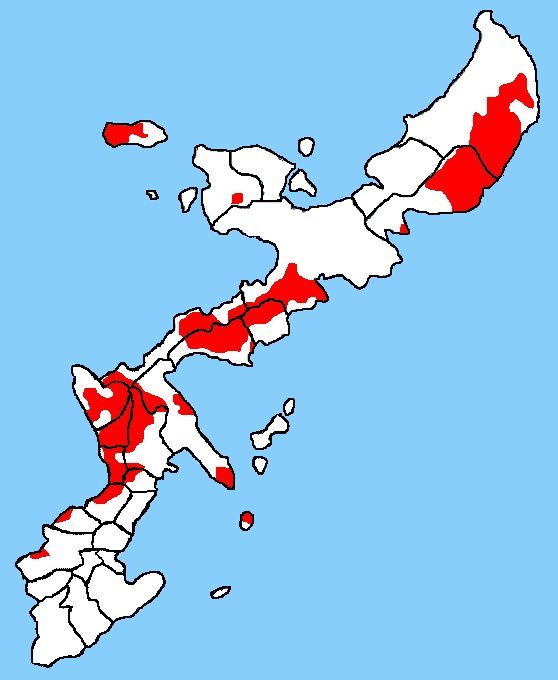
This has not been an entirely happy residence. Numerous incidents, most recently just a few weeks ago, involving off-duty American soldiers committing crimes and accused rapes of Japanese girls have lead to serious protests to the American presence, though the pact that allows the Americans to stay was renewed a few years ago.
Even so, Okinawa remains an extremely popular tourist destination among Japanese (nearly 98% of tourists who come to Okinawa are Japanese, amounting to nearly 5.5 million people [!]), and with good reason: it is gorgeous.
Perhaps I should be more specific; Naha, the biggest city, capital, and transportation hub, is not gorgeous, particularly in the eyes of tourists who step off their flights ready for their tropical adventure. The main island is dominated by the American presence: used car lots advertising prices in both yen and dollars, numerous A&W franchises, and rumbling military caravans were common sights.
The unfortunate Japanese tendency to overdevelop hit southern Okinawa-honto hard. Blank-faced concrete buildings lined the coast, exhaust fumes from the broad highway that runs up the spine of the island filled the air, and the finest beach we could find within a 2-hour bike ride was a man-made one, somewhat mockingly named “Tropical Beach,” though despite the irony of hanging out on a South Pacific island on a man-made beach named Tropical Beach (why not re-name the island Tropical Island?), it felt pretty good to face the open ocean again.

Destined not to spend our “tropical” vacation in a clogged city (though to be fair it had it’s nice spots), Jerich, my travel partner, and I set off for nearby Zamami Island, a two-hour ferry to the west of the main island, with plans to camp on the beach.
Which we did, though we didn’t anticipate the nighttime temperature dropping to below 40 degrees. Even so, it’s hard to beat a campsite from which one can wake up and see this:

Or before going to sleep, see this:

Our second day there, we happened upon a very enthusiastic pair of girls on a graduation trip who invited us to where they were staying that night to hang out. This place, a minshuku, a traditional Japanese guesthouse, would be where we would end up staying the remainder of our trip. A communal experience, a few people would cook each night for all of the guests, who sat (on the ground) around a (low) table in the common room, talking into the wee hours. Given that we were foreigners, these late-night sessions included English lessons, covering a range of topics including proper usage of the phrase “god damn it,” and when it is appropriate to call someone an “asshole.”
The remainder of our time was spent meandering around Zamami and the other islands in the chain, biking, hiking, snorkeling, getting sunburned, and marveling at the fact that in getting away from “it all,” we might have accidentally discovered where “it all” was hiding in the first place.


These guard dogs, called Shisa, are ubiquitous in Okinawan houses, holdovers from the old Ryukyu kingdom. Normally found in pairs, one always has mouth closed, to hold the good spirits of the household inside, the other open, to allow the bad spirits to leave. This one was on top of the minshuku we stayed at.


Thursday, February 28, 2008
A Shameless Plug
I feel a little sheepish posting this, but I hope you'll all forgive the shameless plug, as this is quite exciting for me:
My first published piece!
Thanks to everyone who encouraged me to expand outside the blog!
My first published piece!
Thanks to everyone who encouraged me to expand outside the blog!
Back To School
It was lunchtime when we arrived, five people in two taxis and one via bicycle, at Fuchu Elementary School #10. We were expected, of course, but were welcomed only by shrieking children, each nudging their neighbor, “Hey, get a look at who’s here.”
The “who” – well, “we,” – was the group of students that our university had selected to go to participate in Fuchu Elementary’s International Day: Claire from England, Usu from Cote d’Ivorie, Bibi from China, Samu from Finland, Zare from Brasil and myself, feeling quite unexotic indeed.
As we walked towards the main building, various children gawked, whispered “foreigner” to their friends; a few teachers poked their heads out of classroom windows to say hello and direct us to the principal.
The main entrance to the school was like a regular genkan, the typical entryway to a Japanese home: the floor was a few inches below the floor of the school building, and the walls were lined with hundreds of drawers where the students put their shoes before changing into their classroom slippers. I put on a pair, a few sizes too small, and shuffled over to the principal’s office, where we were seated and offered tea.
The principal’s office was charmingly cluttered. There seemed to be a thin layer of dust on everything. A half-erased chalkboard calendar hung on one wall, flanked by notices and other random-looking papers attached with pushpins. On the other wall, close to the ceiling, hung portraits of the 11 previous principals of the school, ten of whom were business-like men, and one of whom was an absolutely terrifying woman whom I was afraid would materialize at any moment to correct my posture, inform me that my behavior was “unacceptable,” and request a conversation with my parents. Each portrait was angled downward from its point high up on the wall, giving the impression that each principal was watching my every move, looking down at me with disgust and pity. I got the urge apologize for things I hadn’t done. If the pictures were positioned that way as a psychological maneuver to make students afraid of stepping out of line, well… it worked.
All of this in contrast to the current principal, who was so gentle a woman that I feared shaking her hand may crush it. Dressed in a conservative gray frock, she spoke softly and slowly, thanking us for coming because we must be very busy, reiterating how excited the children were to see us. Working in elementary education for 27 years, this was her first post as a principal. Even when speaking about the problems that face elementary school children in Japan (bullying resulting in refusal to go to school, overcrowded classrooms, hyperactive kids [sound familiar?]), she did so with a smile on her face and an attitude that spoke of infinite patience and perseverance. When she cited numbers, she held up as many digits for us to see; for larger numbers, she would extend five fingers on her left hand, in the palm of which she would place the remaining digits from the right hand.
A teacher and a few students came to the door and told us that the performance was about to start. Lead upstairs by an unbelievably nervous boy, who would walk ahead of me, stop, look back to make sure I was still coming, then start walking again before we got too close, we emerged on the roof, where around 120 students were waiting. We sat in front of them; Mt. Fuji was visible behind us, in the hazy distance. One of the students came to the front and, speaking through a megaphone, asked her classmates to be quiet, then welcomed us and said how excited everyone was to learn about our countries.
One by one, the three classes performed songs and dances for us off to the right, as the remaining students in the front row tried to guess which foreigner was from where. Upon their conclusion, each of us was handed the megaphone and asked our opinion of the performances. I can’t quite remember what I said but I do remember being glad that my Japanese teacher wasn’t there to hear it. It appeared that the children were too busy recovering from the shock of seeing foreigners speaking Japanese to care much about my grammar. Thankfully.
The six of us were to go two-by-two to the three different classrooms; I was paired with Samu from Finland, and we were lead to the first classroom by a small group much in the same way I was lead up to the roof, save for one tiny little boy who, in a voice barely over a whisper, and without making any eye contact with me at all, asked me how many people were in my family, how many were boys, and what did I eat at dinner with my family.
My assignment had been to give a presentation about America, but I had been unsure as to what 10-year old Japanese students already knew, or what they wanted to know. I told them about my hometown, about what my elementary school was like, and what I ate for lunch. I asked them what American foods they knew (“Hamburgers!”), what kinds of foods they liked (“Hamburgers!”), and what they thought a normal American student their age ate for lunch (“Hamburgers!”). As for famous American people they knew, their answers, in order of appearance, were, Bush, (they didn’t say which one) Clinton (they didn’t say which one), and Babe Ruth.
When I asked them what other American things they knew, the many of the boys screamed, “Baseball!”
“How about other than baseball?”
Silence.
“Baseball!”
The females of the group asked very good questions, and in general were much better behaved. One girl came up to me afterwards and asked me in all seriousness if I had any children. I did not enjoy this question. Another girl had brought a dreamcatcher her dad had brought back from a business trip to America. I saw her holding it, standing in my general vicinity, eyes towards the ground, looking very nervous. I felt similarly. Getting down to her level, I asked her what it was and if she knew what it was supposed to do. Biting her lip to hold back a smile, I told her that I had had a dreamcatcher when I was younger, too. She relaxed a bit and smiled fully; this melted me.
While preparing for the visit, I thought that the perspective I would gain from going to talk to these kids would be related to my identity as an American, something that I had never thought about fully until I began to feel uncomfortable, why I’m still not sure, claiming it to be “where I’m from.” I was worried about what these children’s image of America would be. Fat? Greedy? Loud? Warmongering? Gun-toting? Would I have to answer questions about the Iraq War, about Hiroshima, about racism?
As it turned out, they really didn’t have much of a well-formed image about America at all. Some had been to Hawaii but did not realize it was part of America. (To be fair, this is probably true of many Americans as well.) It was exactly this that left its mark on me through this experience at the school, and it’s something that I often come upon while traveling. One of the many humbling experiences involved in living abroad is discovering that there is a vast world with no relation to one’s own.
The place I long for and call home, those children had never heard of. The language I speak, they don’t understand. People who have hurt me and those whom I have wronged, who remain in my memory, stubborn and unmoving – those people the children will never meet. It’s an awe-inspiring thing to realize, though it is also at times frightening to think that everything I hold dear and that has contributed to making me who I am are entirely meaningless to nearly the entire world population, save my family and those with whom I am close. With this in mind, it is quite hard to take oneself so seriously as to lose proper perspective, a crime that I’m often guilty of and something that I feel travel is the best cure for.
Back in the principal’s office, the six of us talked again with the principal and some teachers about the visit, and about their students. The conversation came, as it often does, to each of our hometowns. When it was my turn to speak, I told those assembled that I was from San Diego.
One of the teachers’ faces lit up. “San Diego?”
“Yes.”
In English, she said, “San Diego! Blue sky! Freeway!”
As I reflected on this statement as one would a Zen koan, I saw peeking into the room from outside one of the girls from the classes we went to. Meeting her eyes, I smiled and waved softly to her as those around me continued to speak of their home countries. Her eyes widened, and in an instant she was gone. I focused my attention on that spot for the next few seconds, waiting. I couldn’t say why, but I really wanted her to come back.

The “who” – well, “we,” – was the group of students that our university had selected to go to participate in Fuchu Elementary’s International Day: Claire from England, Usu from Cote d’Ivorie, Bibi from China, Samu from Finland, Zare from Brasil and myself, feeling quite unexotic indeed.
As we walked towards the main building, various children gawked, whispered “foreigner” to their friends; a few teachers poked their heads out of classroom windows to say hello and direct us to the principal.
The main entrance to the school was like a regular genkan, the typical entryway to a Japanese home: the floor was a few inches below the floor of the school building, and the walls were lined with hundreds of drawers where the students put their shoes before changing into their classroom slippers. I put on a pair, a few sizes too small, and shuffled over to the principal’s office, where we were seated and offered tea.
The principal’s office was charmingly cluttered. There seemed to be a thin layer of dust on everything. A half-erased chalkboard calendar hung on one wall, flanked by notices and other random-looking papers attached with pushpins. On the other wall, close to the ceiling, hung portraits of the 11 previous principals of the school, ten of whom were business-like men, and one of whom was an absolutely terrifying woman whom I was afraid would materialize at any moment to correct my posture, inform me that my behavior was “unacceptable,” and request a conversation with my parents. Each portrait was angled downward from its point high up on the wall, giving the impression that each principal was watching my every move, looking down at me with disgust and pity. I got the urge apologize for things I hadn’t done. If the pictures were positioned that way as a psychological maneuver to make students afraid of stepping out of line, well… it worked.
All of this in contrast to the current principal, who was so gentle a woman that I feared shaking her hand may crush it. Dressed in a conservative gray frock, she spoke softly and slowly, thanking us for coming because we must be very busy, reiterating how excited the children were to see us. Working in elementary education for 27 years, this was her first post as a principal. Even when speaking about the problems that face elementary school children in Japan (bullying resulting in refusal to go to school, overcrowded classrooms, hyperactive kids [sound familiar?]), she did so with a smile on her face and an attitude that spoke of infinite patience and perseverance. When she cited numbers, she held up as many digits for us to see; for larger numbers, she would extend five fingers on her left hand, in the palm of which she would place the remaining digits from the right hand.
A teacher and a few students came to the door and told us that the performance was about to start. Lead upstairs by an unbelievably nervous boy, who would walk ahead of me, stop, look back to make sure I was still coming, then start walking again before we got too close, we emerged on the roof, where around 120 students were waiting. We sat in front of them; Mt. Fuji was visible behind us, in the hazy distance. One of the students came to the front and, speaking through a megaphone, asked her classmates to be quiet, then welcomed us and said how excited everyone was to learn about our countries.
One by one, the three classes performed songs and dances for us off to the right, as the remaining students in the front row tried to guess which foreigner was from where. Upon their conclusion, each of us was handed the megaphone and asked our opinion of the performances. I can’t quite remember what I said but I do remember being glad that my Japanese teacher wasn’t there to hear it. It appeared that the children were too busy recovering from the shock of seeing foreigners speaking Japanese to care much about my grammar. Thankfully.
The six of us were to go two-by-two to the three different classrooms; I was paired with Samu from Finland, and we were lead to the first classroom by a small group much in the same way I was lead up to the roof, save for one tiny little boy who, in a voice barely over a whisper, and without making any eye contact with me at all, asked me how many people were in my family, how many were boys, and what did I eat at dinner with my family.
My assignment had been to give a presentation about America, but I had been unsure as to what 10-year old Japanese students already knew, or what they wanted to know. I told them about my hometown, about what my elementary school was like, and what I ate for lunch. I asked them what American foods they knew (“Hamburgers!”), what kinds of foods they liked (“Hamburgers!”), and what they thought a normal American student their age ate for lunch (“Hamburgers!”). As for famous American people they knew, their answers, in order of appearance, were, Bush, (they didn’t say which one) Clinton (they didn’t say which one), and Babe Ruth.
When I asked them what other American things they knew, the many of the boys screamed, “Baseball!”
“How about other than baseball?”
Silence.
“Baseball!”
The females of the group asked very good questions, and in general were much better behaved. One girl came up to me afterwards and asked me in all seriousness if I had any children. I did not enjoy this question. Another girl had brought a dreamcatcher her dad had brought back from a business trip to America. I saw her holding it, standing in my general vicinity, eyes towards the ground, looking very nervous. I felt similarly. Getting down to her level, I asked her what it was and if she knew what it was supposed to do. Biting her lip to hold back a smile, I told her that I had had a dreamcatcher when I was younger, too. She relaxed a bit and smiled fully; this melted me.
While preparing for the visit, I thought that the perspective I would gain from going to talk to these kids would be related to my identity as an American, something that I had never thought about fully until I began to feel uncomfortable, why I’m still not sure, claiming it to be “where I’m from.” I was worried about what these children’s image of America would be. Fat? Greedy? Loud? Warmongering? Gun-toting? Would I have to answer questions about the Iraq War, about Hiroshima, about racism?
As it turned out, they really didn’t have much of a well-formed image about America at all. Some had been to Hawaii but did not realize it was part of America. (To be fair, this is probably true of many Americans as well.) It was exactly this that left its mark on me through this experience at the school, and it’s something that I often come upon while traveling. One of the many humbling experiences involved in living abroad is discovering that there is a vast world with no relation to one’s own.
The place I long for and call home, those children had never heard of. The language I speak, they don’t understand. People who have hurt me and those whom I have wronged, who remain in my memory, stubborn and unmoving – those people the children will never meet. It’s an awe-inspiring thing to realize, though it is also at times frightening to think that everything I hold dear and that has contributed to making me who I am are entirely meaningless to nearly the entire world population, save my family and those with whom I am close. With this in mind, it is quite hard to take oneself so seriously as to lose proper perspective, a crime that I’m often guilty of and something that I feel travel is the best cure for.
Back in the principal’s office, the six of us talked again with the principal and some teachers about the visit, and about their students. The conversation came, as it often does, to each of our hometowns. When it was my turn to speak, I told those assembled that I was from San Diego.
One of the teachers’ faces lit up. “San Diego?”
“Yes.”
In English, she said, “San Diego! Blue sky! Freeway!”
As I reflected on this statement as one would a Zen koan, I saw peeking into the room from outside one of the girls from the classes we went to. Meeting her eyes, I smiled and waved softly to her as those around me continued to speak of their home countries. Her eyes widened, and in an instant she was gone. I focused my attention on that spot for the next few seconds, waiting. I couldn’t say why, but I really wanted her to come back.

Subscribe to:
Posts (Atom)